
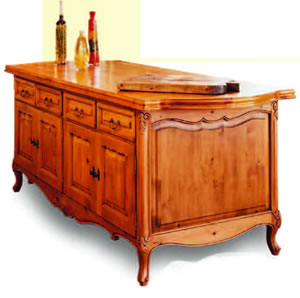
5 Questions You Should Ask When Selecting a Kitchen Island
No item represents the 21st century kitchen more than the kitchen island. Whether you’re building or remodeling, your new kitchen will undoubtedly include one. As kitchens have grown in size and importance, islands have also sprung up in increasing numbers and varieties.
Because of the sheer multitude of options available in today’s kitchen islands, thorough research and a thoughtful assessment of your particular needs is essential to ensure your finished island is everything you desire. The following questions will get you started.
What is the best location?
In many open floor plans, kitchen islands provide separation between kitchens and living spaces, while serving as gathering spots for friends and family. In other layouts, islands are located in the center of the kitchen and are used exclusively as workstations. In either case, it’s important to ensure there is ample clearance to open cabinet and appliance doors and to allow two people to work in the kitchen at the same time.
What activities will be conducted at the kitchen island?
Will it be used for dining? Food preparation or actual cooking? After meal cleanup? Homework or other activities? Different shapes, heights and cabinetry are required for each.
Consider dining. Snack bars attached to islands are usually 30, 36 or 42 inches high. Keeping the whole island one level (usually 36 inches) provides the greatest flexibility. When necessary, the entire surface can be used for cooking or baking. The rest of the time, the overhanging portion can be used for dining.
Raising the snack bar to 42 inches, while maintaining a 36-inch work area, can shield the view of the workspace from an adjoining living area. This arrangement also provides a vertical wall surface for electrical outlets. Lowering the snack bar portion to 30 inches separates the eating area from the 36-inch workspace and allows diners to use standard chairs. This design may be particularly convenient for families with young children. The most common configuration is a long eating bar on one side of the kitchen island, but a snack bar on a shorter, curved end can also accommodate a few diners. Snack bars on two sides allow diners to face each other. Rounded corners will eliminate bruises if someone bumps into overhanging edges.
What features do these activities require?
Because of the island’s isolation, it is essential to include all of the components and specialized storage necessary to carry out its designated function – to eliminate “trips” to other areas of the kitchen.
If the island will be a food preparation site, you will want to include a sink to wash produce, space to chop vegetables, handy access to knives, a garbage disposal or access to a compost bin, room for a wastebasket, and electrical outlets for mixers and food processors. You may also want to incorporate shelves for cookbooks on one end.
Kitchen islands with ranges or cooktops will need an overhead vent hood or a downdraft fan, space for pots and pans, cooking utensils and spices. Installing doors on both sides of the island will eliminate having to reach through the entire width of the island to retrieve stored pots and pans. Eating bars should be raised to protect friends or other family members from cooking spatters.
Islands that border an informal eating area can be a convenient spot to collect and wash dishes – requiring a sink, dishwasher, counter space for air drying, towel racks and storage for dishes and silverware.
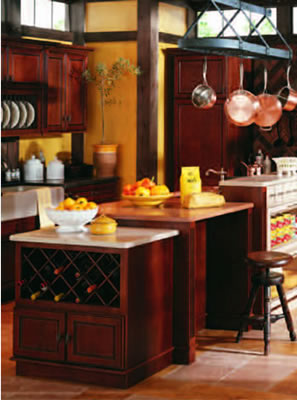
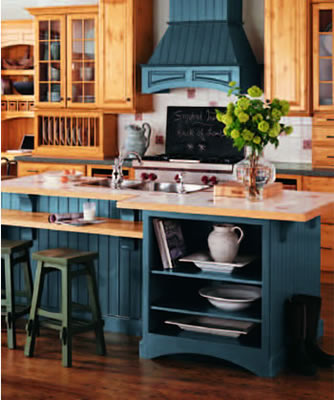
“Lariat Square” cabinetry, Different heights, styles and stains create an interesting island. courtesy of Merillat.com.
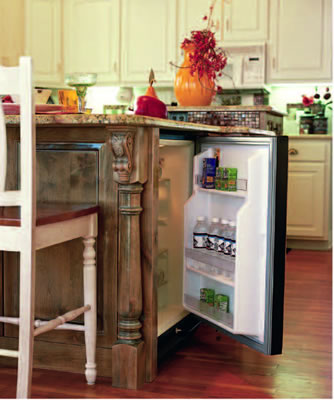
What special amenities would aid your lifestyle?
Islands often provide the opportunity for extras that make life easier, such as an undercounter refrigerator or wine chiller, a warming drawer, or a separate convection oven. Adding a second cooktop or sink allows two cooks to work simultaneously. Tucking a microwave on a side of the kitchen island makes it less obtrusive and frees counter space. A second dishwasher or oven can be a definite plus when entertaining.
What would make the kitchen island a focal point?
Gone are the days when everything matched in a well-planned kitchen. Instead, islands present the opportunity to break the mold by using a unique type of wood or cabinetry style. Adding legs, bump outs, inset areas and open shelving can give an island the furniture look that is currently popular. Countertops often vary as well. Restricting the use of an upscale material like granite or stained concrete to an island gives it added emphasis, while minimizing overall cost. Attractive pendant lights above the island provide a final accent and offer additional task lighting.
Today’s kitchen is the heart of the home, and the island is often the center of its activities.
A myriad of choices in design, materials and features allows you to marry beauty and function to best suit your individual setting and lifestyle.
YOUR DREAM ISLAND WISH LIST
 Unless your space and budget will allow your island to become a continent, you will probably need to prioritize your wishes. The following questions can help you begin the process.
Do you want an unencumbered workspace that can double as a buffet area?
Are you willing to give up island counter space to gain a sink or cooktop?
Do you need casual seating? If so, for how many? What height(s) best suit your needs?
Do you want to maximize storage or are you willing to sacrifice some cupboard space to gain an additional appliance (e.g., a second oven or dishwasher, a microwave, a warming drawer, or an undercounter refrigerator)?
What types of storage will add the most convenience?
Would you like a special drawer for spices or knives?
A roll-out shelf for pots? A slide-out cutting board?
A pull-out waste bin? Slots for baking sheets? Open shelves for cookbooks or displaying collectibles?