
For many years, dishes, utensils, cookware and supplies were organized by groups. Since today’s kitchens are often arranged by zones determined by function (e.g., prep, cooking, baking, serving, clean-up zones), point-ofuse storage has become a practical way to save steps and time. Of course, the storage requirements for each zone vary from family to family. To determine the optimal arrangement for your kitchen, take the following steps:
- Analyze your shopping patterns. Do you stock up on staples, stop for fresh produce daily or shop as needed? How you shop and what items you keep on hand determine the best place to locate and how to structure your pantry.
- Know your cooking habits. Are weekday dinners microwave affairs or three courses from scratch? Do you bake often? Is the pressure cooker or slow cooker used regularly? This will provide insight into how to effectively store your pans, pots and equipment.
- Take stock of the contents of your cupboards. Are you big on canned foods, or are frozen foods a mainstay of the menu? Do you like to toss a pinch or two of exotic seasonings into foods as they cook, or is a bottle of Tabasco about as wild as tastes go in your home? Do leftovers play a recurring role? Do you favor the large economy size for your family of five or six? Must you store food for two finicky cats and a 90-pound dog along with the human members of your family?
- Scrutinize your cleanup methods. Do dishes air-dry on a sink-side rack after being hand washed? Do you fill up the dishwasher over the course of the day and run it every night? Your answers will indicate dish and glassware storage needs.
Cabinet Options
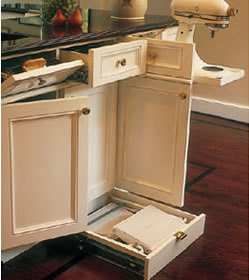
A European innovation that is now finding a more appreciative audience on this side of the pond is the storage plinth. Also known as the toekick, this 5-inch-tall slot of space beneath the base cabinets can be put to work by incorporating shallow drawers. These drawers can hold flat articles that are fairly large – examples include cookie sheets and wire cooling racks, serving platters, a collapsible stepstool, folded kitchen towels and newspapers or magazines bound for recycling.
Base Cabinets
Moving up to examine the foundation of kitchen storage, base cabinets have undergone some progressive changes in the past few years. Comprised of cupboards, drawers and hybrid pullout units, these are the best and most likely places for storing heavy and bulky items. Small appliances that aren’t used daily (such as blenders and food processors) pots, pans and bakeware are the most popular occupants of these cabinets.
There are two types of cabinet configurations: straight runs and corner units. Standard straight-run base units measure 24 inches deep, and their widths are set in 3-inch increments that range from 9 to 45 inches. Fixed shelves – which have subjected cooks to spine-twisting contortions for too many years – are becoming a thing of the past, with more ergonomically sensitive and sensible rollout shelves or trays taking their place. These optional enhancements are inexpensive and easy to retrofit into existing cabinets. Adding them will immediately improve the storage performance of any kitchen without undergoing a major renovation.
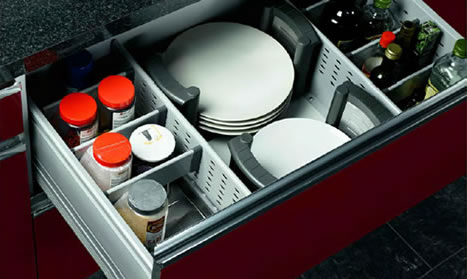
These sturdy cabinet drawers can store heavy dishes. Removable dividers let you configure interiors.
photo courtesy of Kraftmaid Cabinetry
Dish up storage
For everyday dishes, here are several appealing approaches to storage:
- Store them in large, deep drawers. Line the bottom of the drawers with pegboard, and use moveable pegs to corral plates and bowls in neat stacks.
- Plate racks, on their own or integrated into a bank of cabinetry, put your dishware on display while keeping it handy.
- If you intend to use a built-in plate rack for drying your dishes, make sure it’s installed where the wet dishes can drip intot he sink either directly or by means of adrainboard.
- Should you choose to keep dishes in a cupboard, check out the array of minishelves that allow you to separately stack plates of different diameters so that you can easily get access to them one at a time. A word about glass-fronted cabinets: unless you have immaculately kept cupboards, artfully filled with beautiful glassware and dishes, think twice before giving the allclear on this door-style option. Instead, consider using seeded, ribbed, frosted or tinted glass panels on the door. You’ll still reap the benefits from a lighter look, but you won’t have to suffer the full exposure of your cabinets’ not too neat or attractive contents.
These sturdy cabinet drawers can store heavy dishes. Removable dividers let you configure interiors.
photo courtesy of Kraftmaid Cabinetry,
photo courtesy of Tony Giammarino/Giammarino
& Dworkin, Design: Marge Thomas
Drawers
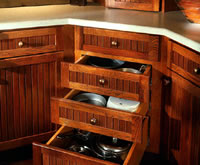
Within a straight expanse of cabinetry, deep drawers are increasingly offered as an appealing alternative to cupboards for several reasons. First, they conserve motion: only one action is required to get access to drawers, versus two – opening the door and bending to see inside – for cabinets with doors. Full-extension glides that allow the drawers to be pulled all the way out, thus bringing the contents to you, make it easier to see and reach what’s inside. Finally, deep drawers can generally support more weight than slide-out shelves.
Drawers can also be fitted with quite an assortment of accessories. Bakers will find covered breadbox inserts in clay or metal handy for keeping the fruits of their labors fresh. Acrylic or stainless-steel bins for flour and grains keep canisters off the counter and a ready supply on hand.
Baskets
Some cabinet manufacturers offer woven baskets dropped into a wooden frame that fits into side-mounted drawer slides. In a kitchen with a rustic or traditional theme, a stack of two or three of these can provide convenient pull-out ventilated storage for certain varieties of produce while adding an interesting note of texture to the room.
Herbs and spices are stowed stove side, where they’re frequently used during cooking. Photos courtesy Mark Samu, Design: Jean Stoffer Designs, Ltd.
Inserts
Standard 5-inch-deep drawers remain a vital stap le in the kitchen. Scaled for utensils and silverware, even existing drawer storage can be maximized with segmented or tiered cutlery inserts. For maximum flexibility, look for trays with adjustable compartments or use individual bins that hook together.
Pullout cabinets
Pullout cabinets combine the convenience of drawers with the capacity of cupboards. They can range from a pair of narrow base-cabinet spice units that conveniently flank the stove to a towering 6-foot-tall pantry that can house just about anything.
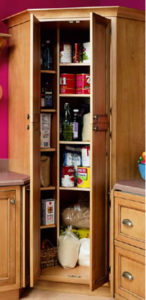
A full-height pantry cabinet reclaims an otherwise underutilized corner of the kitchen. Photo courtesy of Plain & Fancy Custom Cabinetry.
Such full-height cabinets should be organized with larger, heavier articles at the bottom and frequently used items on the shelves at knee-to-shoulder height. If possible, opt for adjustable shelving so you have maximum storage flexibility. Store food staples in groups with separate shelves for baking ingredients, breakfast items, snacks and dry items, such as rice, grains and pasta.
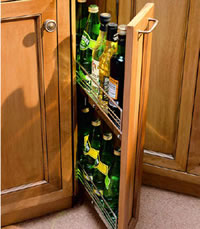
Even awkward angles can supply a slice of productive storage. Photo courtesy of Plain & Fancy Custom Cabinetry.
Corners
The 90-degree, turn-of-a-corner cabinet is by nature space squandering, leaving the curved wedge of room at the rear of the corner almost completely out of reach. A 45-degree corner base cabinet is more forgiving, but its primary benefit is really felt at the countertop level, where the additional surface area can accommodate a cooktop or sink.
The door treatments for corner cabinets differ on a case-by-case basis and may affect how efficiently you can utilize the cabinet. A pair of doors may split open down the center. In kitchens with clearance issues, a doublehinged door can open, fold in on itself andthen swing aside. In some instances, there may be only one door to a corner cabinet, a particularly uncomfortable condition that’s known as a “blind corner.”
While this may sound ominous for storage possibilities, the situation is salvageable. Inserts – those wire, plastic or wood shelves, spinners and sliders that can convert an empty-box cabinet into a shining example of custom-made storage – will rescue the most recalcitrant corner.
There are numerous forms of cornercentric inserts. One solution to a blind corner is to fit it with what’s sometimes called a “magic corner.” This is a set of shelves that’s joined in the middle; with one end attached to the corner-cabinet door, the shelves automatically unfold outside the cabinet when the door is opened. Other examples of angular space saviors include two- or three-level carousels and lazy Susans. The former, which is also fastened to the inside of a cabinet door, rotates 270 degrees; the latter spins a full 360 degrees.
Finally, a spinning, three-bin recycling center may be the best use of a corner base cabinet. Accessibility isn’t an issue, as each container rotates to the fore of the cupboard. Trash talking. Because trash and recycling bins are used several times each day, the location of each is an important consideration. Here are some tips to make them more convenient:
Plan a cutout in the countertop that allows you to drop vegetable peels and other non-protein food scraps into an undercounter bin that can be carried to the
compost pile daily.
Concealed trash bins that tilt out or pull out on a platform installed on drawer slides not only save floor space and keep pets out of the trash, but conserve time and motion. You’ll find many configurations, including models that hide behind a single cabinet door and conceal from one to three bins, so you can recycle at the same spot where you dispose of trash.
If your kitchen has a pullout chopping board, consider installing a pullout trash bin in the cupboard below it. Clearing cuttings off the board becomes a one-step operation.
Countertop Storage
To prevent countertop storage space from looking too jumbled, consider an appliance garage. When this cabinetry concept was first introduced, it wasn’t a particularly pretty sight: a clunky box pushed into the corner of the counter that usually featured a wooden tambour door, which had a tendency to stick. But with advances in cabinet hardware come advances in design. Hinged panel doors that flip up to open, or doors that slide back along the sides of the cabinet, have opened up more attractive appliance garage possibilities. If building codes in your area allow, you may be able to put an electrical outlet inside the garage.
Here’s a novel, more architectural twist on countertop storage. Lately, there’s been a lot of interest in setting a couple of shallow drawers right on the counter, topping them with an elongated hanging wall cabinet. This column-like design not only adds a vertical note to the kitchen, but the assembly is a deft combination of storage types that’s responsive to the needs of the user.
Wall Storage
A simple way to get more storage mileage out of a standard 4-inch-tall backsplash is to top it with a 3-inch-wide ledge. This makes a fine perch for small collectibles or jars of herbs and seasonings and lends a custom finish to an otherwise boring detail.
Rails and rods
Rail or rod systems are not at all difficult to install (even on tiled surfaces), but give some thought to the best place to locate them. While having ladles, tongs and mixing spoons suspended close to the cooktop sounds likes a great idea, there’s a potential drawback. They’ll be directly exposed to steam and grease. If you don’t mind the additional cleanup, you’ll appreciate the convenience; if you do, look elsewhere for this kind of storage.
Wall cabinets
Several different paths are available for installing wall cabinets. The soffits can be boxed in to be flush with the face of the cabinets or remain open. The first treatment gives a clean, built-in look to the cabinetry but eliminates what amounts to a commodious, yet inaccessible shelf. An open soffit, on the other hand, leaves the tops of the wall cabinets unenclosed, and so depending on which way you tend to look at collectibles on display, provides either a spacious band of high-level display space or a roosting spot for dirt and grime.
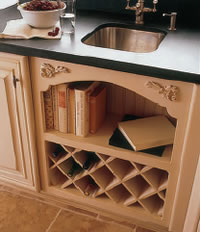
A small wine rack and an open shelf for cookbooks creates interest while providing maximum accessibility. Photo courtesy of www.AlanShortall.com
Open shelves
While they are perfect for putting your collection of majolica platters or antique coffee grinders on exhibit, open shelves are also suspectible to collecting dust. Used as an accent element, they give visual relief to the monolithic look of solid-front cabinets.
Even though they’re just 12 inches deep, wall cupboards have an uncanny way of swallowing up the item you’re trying to find. Luckily, there’s now an abundance of storage-supplementing inserts available for wall-hung cabinets.
Bottle and jar organizers
Bottles and jars revolve into view when placed on a mini lazy Susan. Stair-step organizers literally boost the visibility of back-of-the-cabinet contents. For those who need a bit of extra help in reaching upper shelves, there’s a double-decker insert that pulls down and out of the cabinet to make life easier.
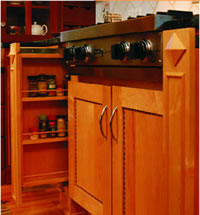
Herbs and spices are stowed stove side, where they’re frequently used during cooking. Photos courtesy Mark Samu, Design: Jean Stoffer Designs, Ltd.
Storage for spices
The inside of the upper cabinet doors is a great spot for storing spices. Look in retail storage supply stores and catalogs for a variety of bins and baskets designed to attach to the inside of the doors. Before installing, make sure the unit is positioned clear of the shelves inside the cabinet, or the door won’t close properly.
Pot racks
Best suspended over an island or peninsula to avoid banging your head, hanging pot racks offer practical storage as well as an eye-pleasing focal point. If you’ve got lots of pots, shop around for a model that has a center shelf as well as hooks, or divvy up your collection on more than one rack. Make sure any hanging rack is secured to structural members in the ceiling, and resist the urge to position it too close to burners, or your pans will be enveloped by greasy cooking vapors.
Carefully prioritizing your personal storage needs, considering your available space and exploring the latest organizational components will ensure your new or revamped kitchen makes cooking easier and more enjoyable!